Reinforcement Learning
Learning to Walk with PPO
Teaching a two-legged robot to walk with Proximal Policy Optimization.
3,000
episodes
In short
I taught a simulated two-legged robot to walk from scratch. It starts out flailing and falling over, and is only rewarded for moving forward and penalised for falling. I implemented the Proximal Policy Optimization (PPO) algorithm myself in PyTorch, and after 3,000 episodes of trial and error the robot walks steadily.
Problem
BipedalWalker (Gymnasium, Box2D) observes a 24-dimensional sensor vector: hull angle, velocities, joint positions and lidar readings. Each step it must output four continuous torques, one per hip and knee joint. Continuous actions rule out simple value-based methods like DQN, so the agent has to learn a stochastic policy directly.
Approach
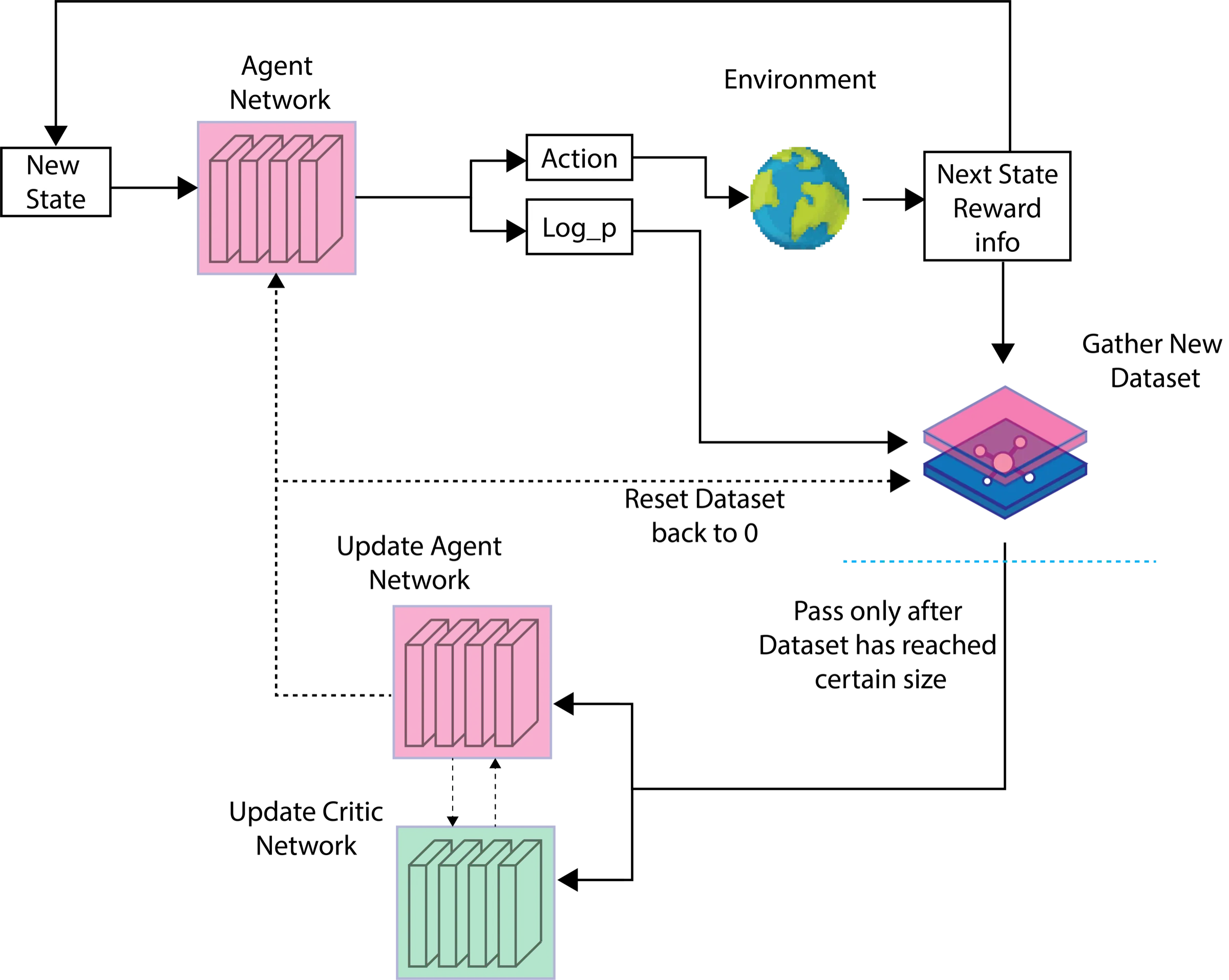
PPO uses two networks. The Actor (policy) maps the state to a Gaussian over actions: it outputs a mean and, via softplus, a standard deviation for each joint. The Critic estimates the state value V(s). Both are MLPs with two hidden layers of 376 units, LayerNorm and ReLU.
Training alternates between two phases. The current policy collects 4,048 transitions into a rollout buffer. Then actor and critic train on that buffer for 5 epochs in minibatches of 32, and the buffer is cleared. The advantage is the one-step TD error r + γV(s′) − V(s) with γ = 0.99. The policy loss is PPO’s clipped surrogate objective (ε = 0.2), which stops a single update from moving the policy too far. The value loss is a Huber loss, and a small entropy bonus keeps exploration alive. The loss weights (1, 1, 0.0015) and a low learning rate of 1e-5 with Adam took the most tuning, along with getting right which tensors to detach from the gradient graph.
Result
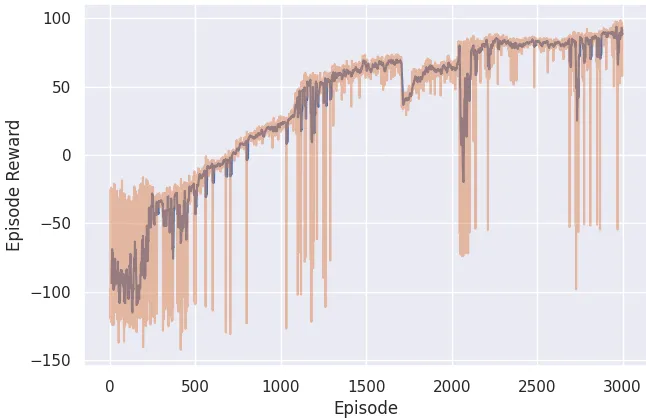
The episode reward climbs from around −100, when the robot keeps falling over, to about +100 by episode 3,000. The occasional sharp dips are episodes where it still falls. The trained actor was exported to ONNX.
Tech: Python · PyTorch · Gymnasium (Box2D) · PPO · actor-critic · ONNX