Computer Vision
Self-Supervised Unpixelation
A CNN that restores pixelated images — trained without a single label.
Problem
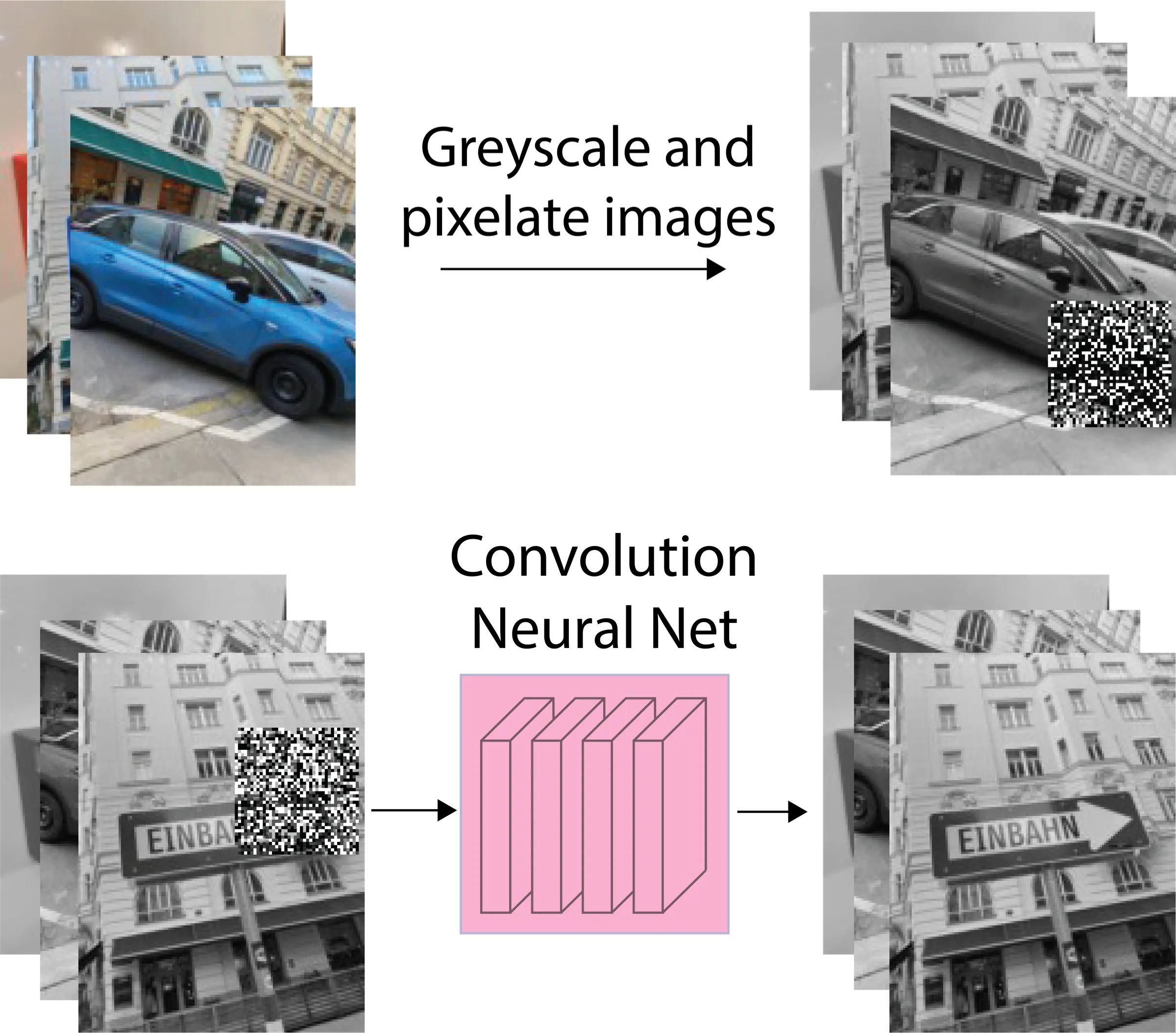
Pixelation hides part of an image. I wanted a network that can restore it, without anyone having to label training data by hand. This is an ill-posed inverse problem: many different originals produce the same pixelated block, so the model has to learn what natural images usually look like.
Approach
The trick is that the training data labels itself. We collected around 35,000 photos ourselves. I converted them to grayscale, resized them to 64×64 and pixelated a random rectangle in each one (4–32 px per side), replacing it with block averages of 4–16 px. The original pixels become the ground truth, so every image is a free training pair.
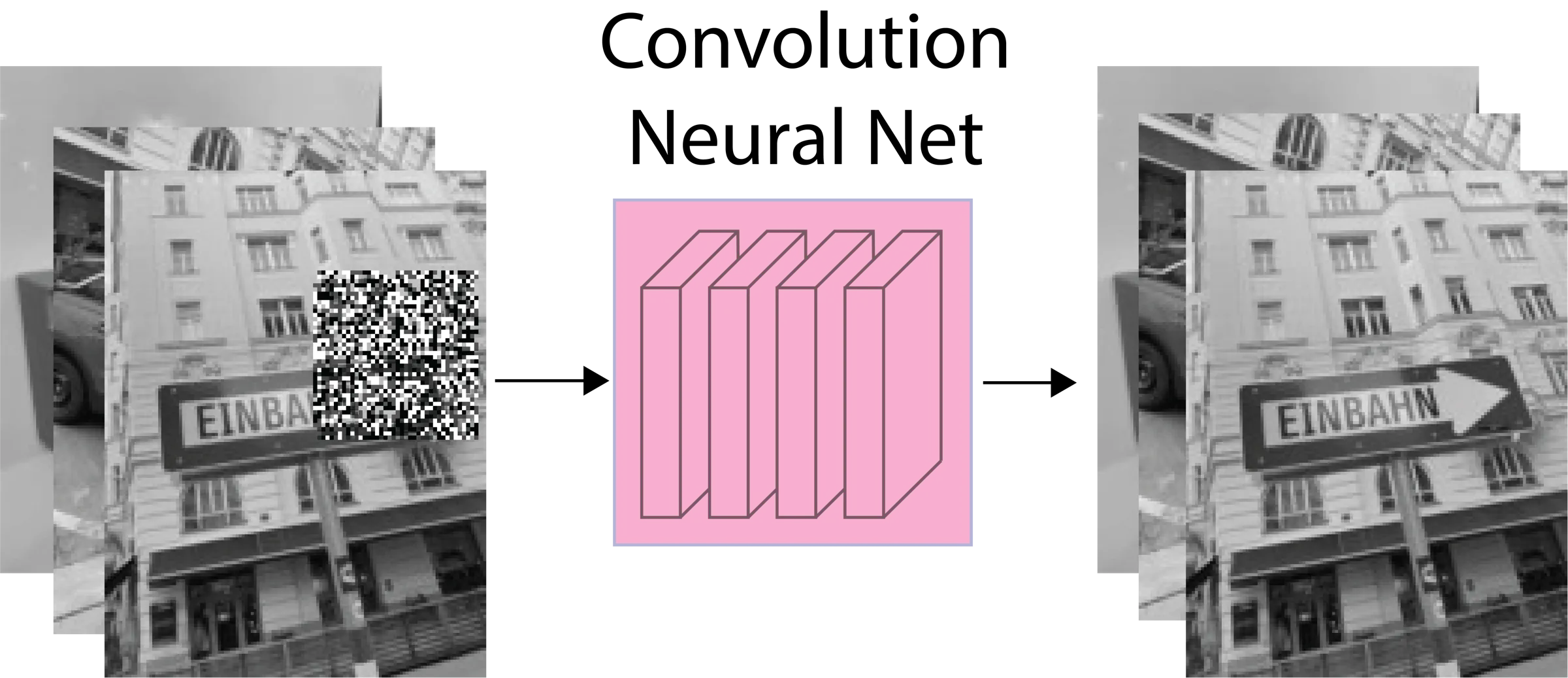
I built the whole pipeline from scratch in PyTorch: preprocessing, a custom dataset with seeded random pixelation, batching and the training loop. The model is deliberately simple: a fully convolutional network with 9 layers of 3×3 kernels, 128 channels, batch normalization and ReLU. Same-padding keeps the output at full resolution, so the network predicts a value for every pixel. Stacking nine 3×3 layers gives each output pixel a 19×19 receptive field, enough context to combine the coarse block averages with the visible structure around them.
The loss is a masked MSE: it only counts the pixels that were hidden, so the network spends its capacity on reconstruction instead of copying the visible part. I trained with Adam on an 80/20 train/validation split on an Apple Silicon GPU, with checkpoints every epoch and early stopping on validation loss.
Result
The network unpixelates images it has never seen. The final benchmark was 6,635 unseen pixelated images, scored by RMSE against baseline models.
Tech: Python · PyTorch · NumPy · fully convolutional CNN · masked MSE · self-supervised image restoration