Generative Models
GANs & Adversarial Examples
A generator learns to fool a discriminator — and I learn to fool classifiers.
In short
I built a GAN in PyTorch that learns to draw handwritten digits, and on the way I looked at the other meaning of “adversarial”: how easily a trained classifier can be fooled.
Problem
A classifier that recognises digits doesn’t really understand them. Small, targeted changes to an image can make it fail. The same trick, aimed at the right network, can also be used to create new images.
Approach
Fooling a classifier. I trained a small CNN on MNIST, then attacked it with projected gradient ascent: nudge the pixels in the direction that increases the loss, but keep every change within a small budget so the digit still looks like itself.
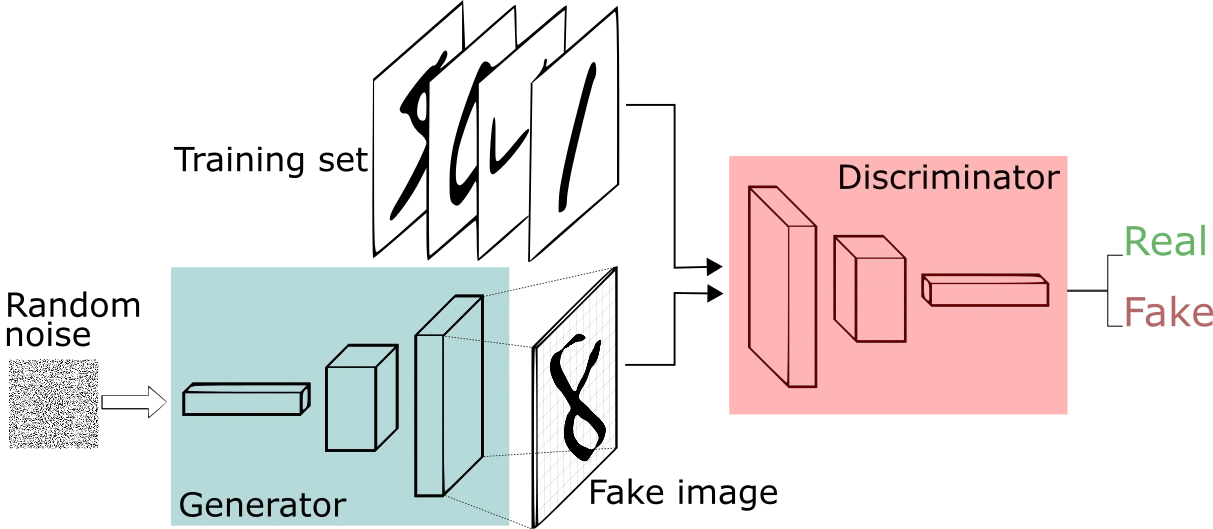
From attacks to generation. Next I trained a discriminator to tell real digits from fakes. The fakes start as noise, and after every epoch the same attack pushes them to look more “real”. Better fakes make a stronger discriminator, and the other way round.
The GAN. Finally, a generator network replaces the attack. It turns random vectors into images and is trained to fool the discriminator, while the discriminator is trained to catch it: a min-max game. Each network is updated only with its own loss.
Result
Small, bounded changes to the pixels are enough to make the classifier get digits wrong. The GAN learns to turn random noise into new digits.
Tech: Python · PyTorch · CNNs · projected gradient ascent · GAN