Generative Models
Normalising Flows on MNIST
Generating digits by inverting a learned, invertible transformation.
In short
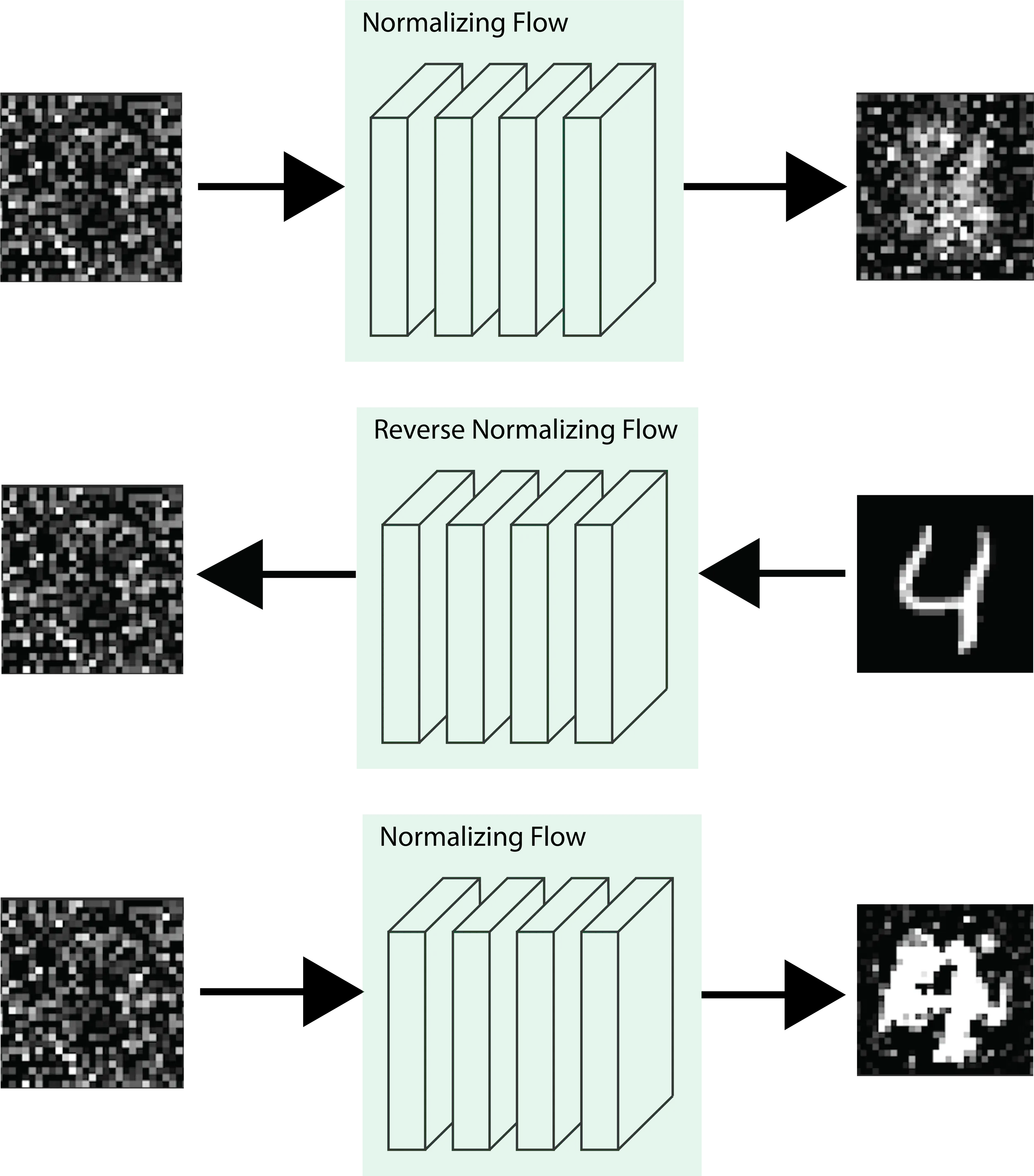
I built a normalising flow in PyTorch: a stack of invertible layers that turns MNIST digits into Gaussian noise. Run it backwards, and noise turns into new digits.
Problem
Most generative models can sample new data but can’t tell you how likely a given example is. Normalising flows can do both, because every step is invertible. The catch: ordinary neural networks aren’t.
Approach
I flattened MNIST digits into 784-dimensional vectors and built the flow from 5 additive coupling layers. Each one splits the pixels in half, keeps one half as it is and shifts the other by an amount a small network computes from the first. That is easy to undo, and the halves swap from layer to layer so every pixel gets transformed.
Using the change-of-variables formula, the model is trained by maximum likelihood: it minimises the negative log-likelihood of the digits under a standard Gaussian, including the log-determinants of the Jacobians.
Result
To generate a digit, I sample from the Gaussian and run it backwards through the flow. Out come new digits.
Tech: Python · PyTorch · additive coupling layers · maximum-likelihood training