Sequence Models
LSTM Text Generation & Compression
Predicting the next character — and using that to compress text.
In short
I trained a character-level LSTM in PyTorch on transcripts of Donald Trump’s speeches. It reads text one character at a time and predicts the next one. I used those predictions twice: to write new text, and to compress text by giving the characters it expects the shortest codes.
Problem
A model that predicts the next character well has learned the structure of a language. Generating text shows that directly; compression puts a number on it: better predictions, fewer bits per character.
Approach
The text is split into non-overlapping sequences, and each character is mapped to an index in a small alphabet (letters, digits, space and . ! ?). Unknown characters become spaces.
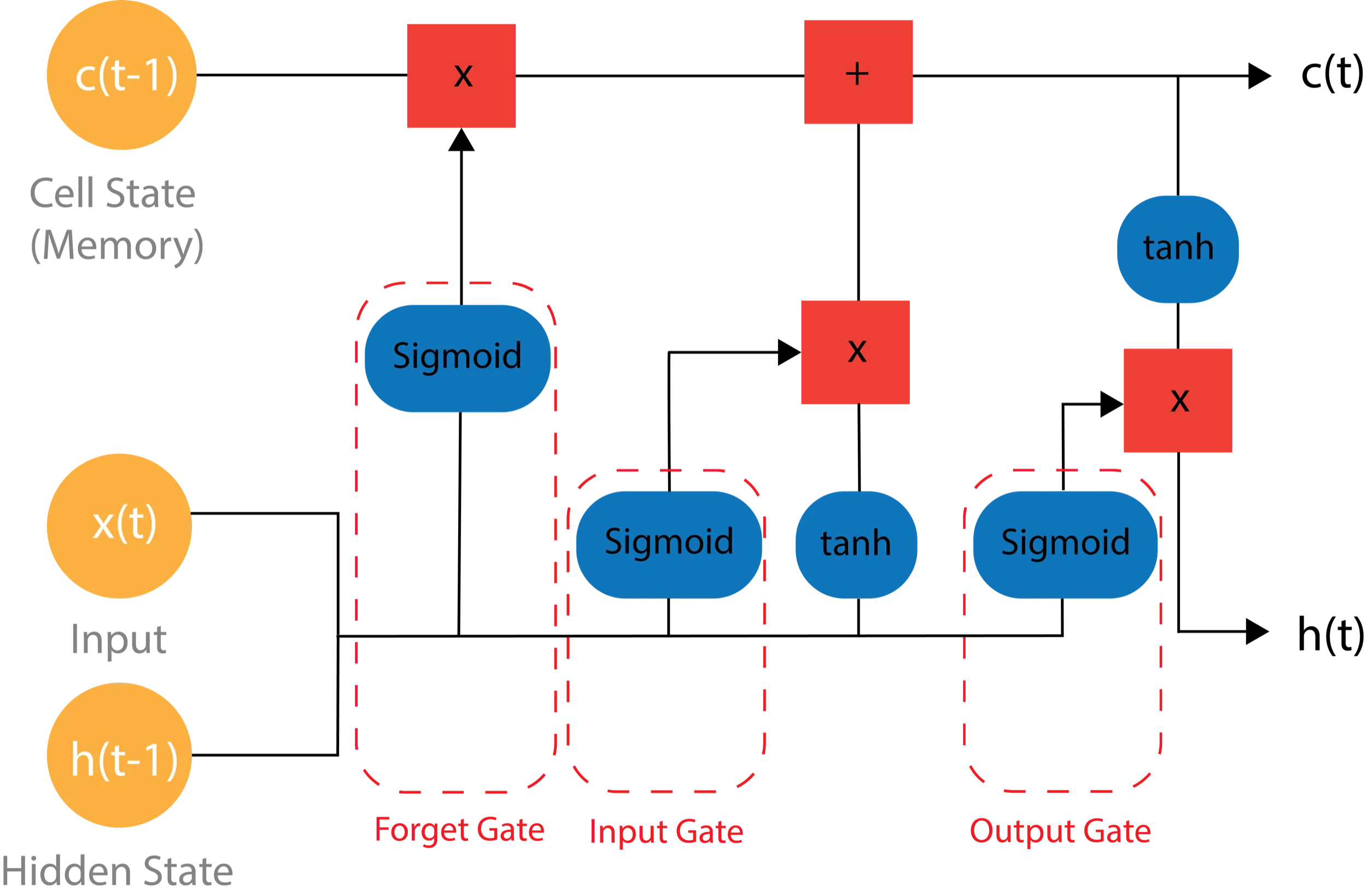
The model has three layers: a learned embedding turns each character into a vector, an LSTM carries a memory along the sequence, and a linear layer outputs a score for every character in the alphabet. Training is many-to-many: the target is the input shifted by one character, so the model predicts at every position. It uses cross-entropy loss and Adam, and the checkpoint with the lowest validation loss is kept. I also measured top-k accuracy for every k: how often the true next character is among the model’s k best guesses.
Generation: starting from a seed like “I am a”, the next character is sampled with the Gumbel-Max trick: add Gumbel noise to the temperature-scaled scores and take the largest. The temperature τ sets how adventurous the text gets.
Compression: a Huffman code gives frequent symbols short bit strings and rare ones long ones. The baseline builds one fixed code from character frequencies in the training text. The LSTM version builds a new Huffman code at every step from the model’s predicted probabilities, so the expected next character costs only a few bits. I tuned a softmax temperature for this and compared bits per character on the validation set.
Result
The LSTM writes new text character by character, and its predictions drive an adaptive compression scheme.
Tech: Python · PyTorch · LSTM · Gumbel-Max sampling · Huffman coding